17 September
The landings
American, British and Polish airborne forces landed along a corridor through Eindhoven, Nijmegen and Arnhem. British 1st Airborne Division had the most distant objective: the bridge over the Lower Rhine.
 Where to buy
Back to Spectrum
Where to buy
Back to Spectrum
Autumn 2026 · Remembrance brew
Brewed to remember. Sold to raise funds.
Created by Spectrum Bier to honour those who have served, Pegasus raises funds for The Parachute Regimental Association and Support Our Paras, helping them care for serving soldiers, veterans and airborne families.
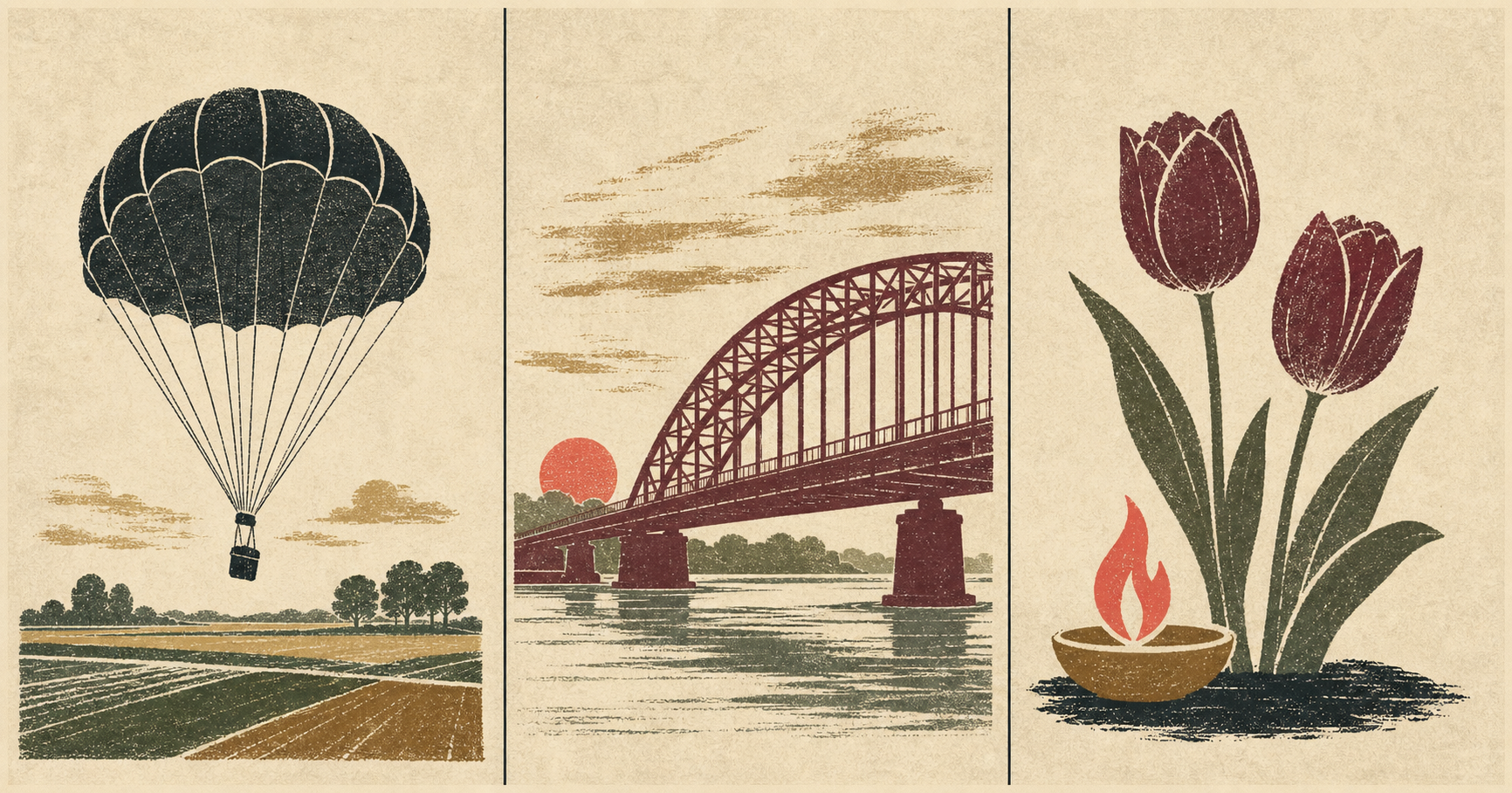
For those who came from the sky
For those who sheltered them
For those who remember
Why Pegasus
Pegasus is the emblem of British Airborne Forces. It is also the name of an extraordinary act of cooperation after the Battle of Arnhem.
When Allied troops were left behind in German-occupied territory, Dutch families and resistance groups hid, fed and guided them. On the night of 22–23 October 1944, Operation Pegasus brought 138 evaders, mostly survivors of Arnhem, across the Lower Rhine to Allied lines.
That escape belongs to both histories: the courage of the Airborne soldiers and the courage of the Dutch people who risked everything to bring them home.
17–25 September 1944
Operation Market Garden was an ambitious attempt to secure a route across the Netherlands and over the Rhine. Arnhem was the final bridge, and the point where the plan broke down.
17 September
American, British and Polish airborne forces landed along a corridor through Eindhoven, Nijmegen and Arnhem. British 1st Airborne Division had the most distant objective: the bridge over the Lower Rhine.
Nine days
A small force reached the Arnhem bridge. Cut off from reinforcement, and facing stronger German resistance than expected, British and Polish troops held positions at Arnhem and Oosterbeek against overwhelming odds.
25 September
The final bridge was not secured. Just over 2,000 of approximately 10,000 men of 1st Airborne Division returned across the river. Thousands were killed, wounded or taken prisoner.
The operation did not achieve its main objective. What endured was the courage of those who fought, the suffering of civilians, and a bond that still brings Dutch and Airborne communities together.
A living bond
Remembrance at Arnhem is not a distant ritual. It is a relationship renewed every year.
Dutch children laid flowers at the graves in Oosterbeek in September 1945. The annual Airborne Memorial Service followed from 1946 and is still organised by a Dutch team, supported by more than 100 volunteers and members of the British, Polish and Dutch armed forces.
Veterans and families return. Local people gather. Stories pass from one generation to the next. Gratitude becomes friendship, and friendship becomes care.
We remember the fallen. We honour the helpers. We support the living.
Available to order
Every bottle and keg helps raise funds for the PRA and Support Our Paras, carrying remembrance forward through gratitude, fellowship and practical support.
Trade & event enquiries
Pegasus is available in bottles and kegs for bars, shops and events. Tell us what you need and where you are; our sales team will come back to you about availability, quantities and delivery.
See where to buy PegasusMake a direct donation
Buying Pegasus raises funds for The Parachute Regimental Association and Support Our Paras. If you would also like to donate directly, these three routes support different parts of the airborne story.
Spectrum Bier is only the signpost. We do not receive, process or recommend any donation. Your gift goes directly to the organisation you choose.
Practical support
Donations help Support Our Paras care for serving soldiers, veterans and families through hardship, mental health support, mobility needs, employment and training, and compassionate costs.
Donate to Support Our Paras Support Our Paras is the trading name of registered charity 1131977.
History and heritage
Donations help Airborne Assault ParaData preserve, interpret and display the history of The Parachute Regiment and Airborne Forces through its museum and growing digital archive.
Donate to ParaData Airborne Assault is registered charity 1126776.
Regimental community
Donations support the PRA's work connecting past and present members, organising remembrance and reunions, and helping serving personnel, veterans and dependants facing need or distress.
Donate to the PRA The Parachute Regimental Association is registered charity 214015.The beneficiaries
Pegasus raises funds for two organisations whose work provides care, connection and practical support across the airborne family.
Find out more
Operation Market Garden was an international story. These four perspectives lead to national collections, records and first-hand accounts.
British archives
Dutch archives
United States archives

Polish archives